
SAML SSO
BYOD sign-in for guests who already have an account with your identity provider. Uses the Organization's Self-Service IdP — which user gets through is controlled by the Sign-In Context's Access Policy.
SAML SSO — labelled SAML Logins in the admin — lets guests sign in to the Captive Portal using their existing corporate or Organization account instead of creating a new credential.
Captive Portal SAML uses the Organization’s Self-Service identity provider (configured once under Organization → Accounts → Federation). The same IdP that lets your colleagues sign in to the Self-Service Portal also lets them sign in through the Captive Portal on any Sign-In Context where the module is enabled. Who actually gets through is decided by the Context’s Access Policy — see below.
How a guest signs in
Section titled “How a guest signs in”- The guest picks SAML on the Captive Portal.
- Their browser is redirected to the Organization’s Self-Service IdP.
- After IdP authentication, the browser returns to the portal with a signed SAML assertion.
- Netgraph validates the assertion, then consults the Access Policy for this Context. The policy decides whether this identity is allowed through.
- If allowed, network access is granted.
Who gets through: Access Policy filtering
Section titled “Who gets through: Access Policy filtering”Authentication and authorization are separate:
- Authentication — “is this person’s IdP account valid?” — handled by the Self-Service IdP.
- Authorization — “should this authenticated person get access on this Context’s Captive Portal?” — handled by the Access Policy.
A Captive Portal SAML sign-in only succeeds when both line up. On each policy’s Sign-In Permissions → SAML Login sub-tab:
- SAML Login — master flag. Must be on for SAML to appear on the portal for guests matched by this policy.
- Max devices — per-identity device cap.
- Redirect — where the guest lands after a successful SAML sign-in.
- Session length — a fixed timeout or a concrete end date. Only the flag chosen on Ticket policy is used — the other field is ignored.
Which SAML identities a policy catches in the first place is
governed by the policy’s Applies To email patterns. For
example, a policy with @your-company.example on Applies To
only accepts SAML identities with that email-domain suffix.
See Access Policies for how to decide which policy a given guest matches.
Activate the module on the Context
Section titled “Activate the module on the Context”Prerequisite: the Organization has a Self-Service IdP configured (see Organization SAML authentication). Without that, the Captive Portal SAML module has nothing to authenticate against.
-
Open the module
Sign In Modules → SAML Logins inside the Sign-In Context.
-
Activate
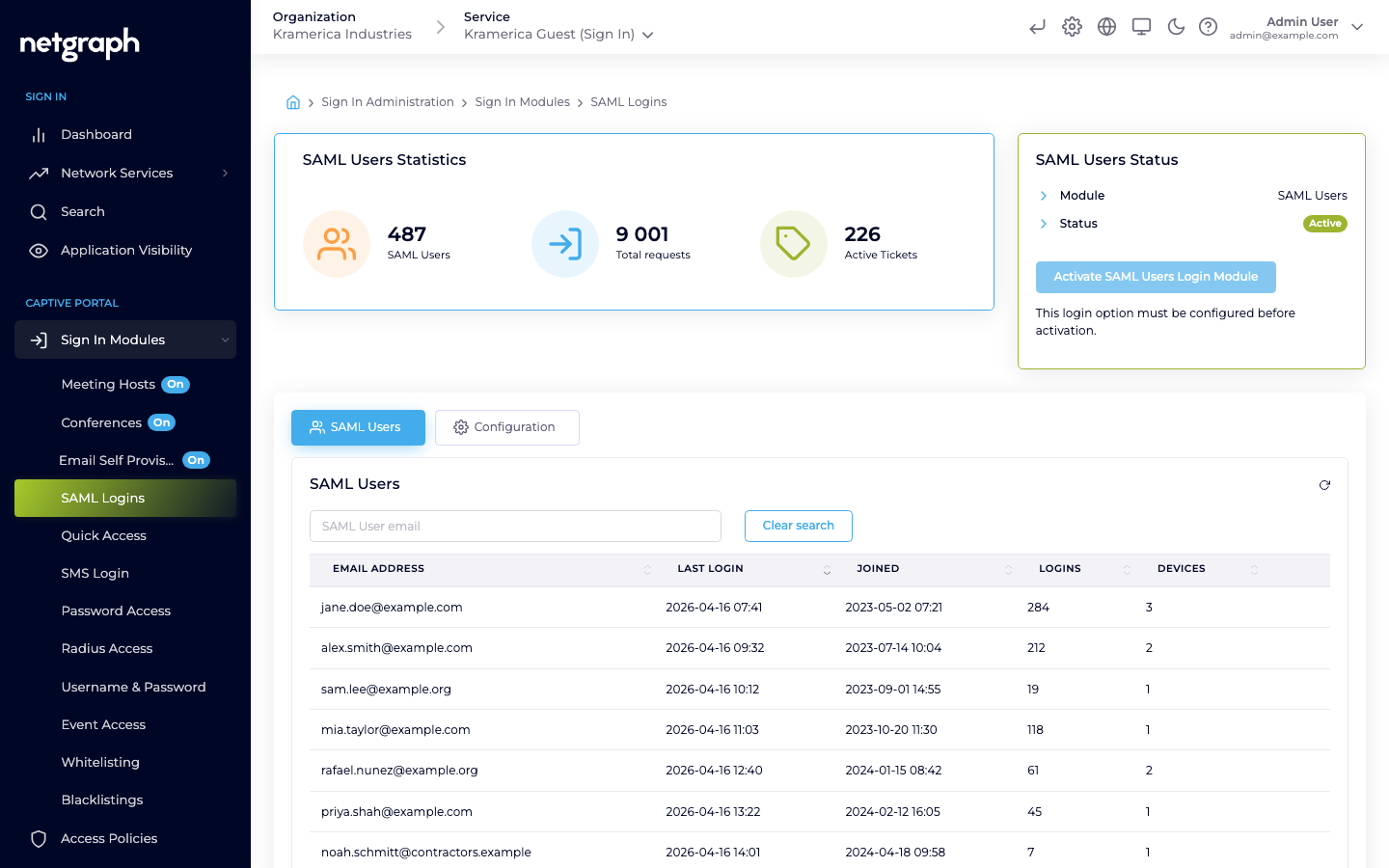
Click Activate SAML Users Login Module. The module is now available to Access Policies.
-
Enable SAML provisioning in the relevant Access Policy
Captive Portal → Access Policies → the policy you want SAML on → turn on the SAML provisioning flag. This is the switch without which SAML will never appear on the portal for guests matched by this policy.
-
Configure walled-garden entries
Guests’ browsers must reach the IdP before sign-in completes. Add the IdP’s hostnames to the Captive Portal walled garden — see the IdP setup guide for the specific hostnames per IdP.
-
Test with a non-admin account
Sign in as a regular user from a clean browser session. Confirm the round-trip completes and a login appears in the Context’s Dashboard.
Managing SAML guests
Section titled “Managing SAML guests”The main tab lists SAML-authenticated guests by email with last login, total logins, and device counts.
- Filter by email.
- Revoke a guest — future sign-ins require another SAML round-trip (and still have to pass the Access Policy).
Compared to Organization-Admin SAML
Section titled “Compared to Organization-Admin SAML”Two separate configurations live under Organization → Accounts → Federation:
| Target | Audience | Used for |
|---|---|---|
| Admin Portal | Organization administrators | Signing in to the Admin Dashboard |
| Self Service | Organization’s end users | Self-Service Portal and Captive Portal SAML |
A change to the Admin Portal IdP never affects guest Captive Portal sign-in, and vice versa.
MFA in the Captive Portal
Section titled “MFA in the Captive Portal”Multi-factor prompts can be difficult during Captive-Portal sign-in — many devices restrict multitasking while captive, so the guest can’t easily open an authenticator app. If MFA becomes a blocker, your IdP may support conditional policies that skip MFA specifically for the Captive Portal application. See SAML IdP setup → disabling MFA for the Captive Portal.